


Flock Insider: Polish Chickens
- Rachelle Shepherd
- Jun 11, 2023
- 12 min read

Updated: Jul 23, 2023
Have you ever seen a chicken with a "mohawk" or a "poof" on the top of it's head? If so, more than likely, it was a Polish chicken!
They are our favorite chicken breed here at Chicky Babies Poultry House!

Are Polish as Funny Acting as They are Looking?
If you are looking for a chicken to add some fun and flavor to your yard, look no further than the Polish chicken! Polish are silly, they look funny, and they are really fun to watch interact with the other chickens. They love to chase each other around for treats or sunbathe together. They make funny clucking noises and rumbles that are as unique as they are. They come in funny colors too - white crested means white topped or white mohawked with another color on their neck and body, usually blue or black. Not many chickens come with the tops of their heads one color and their bodies another!
Then there is their hairdo - what is up with that? Polish are one of the few "crested" breeds in the world which means that they have a poof of feathers on top of their heads in a mohawk style. The hens are described as having "pom-poms" on their heads, whereas the roosters have a more "untamed look," with feathers flowing in all directions like Fabio's hair!
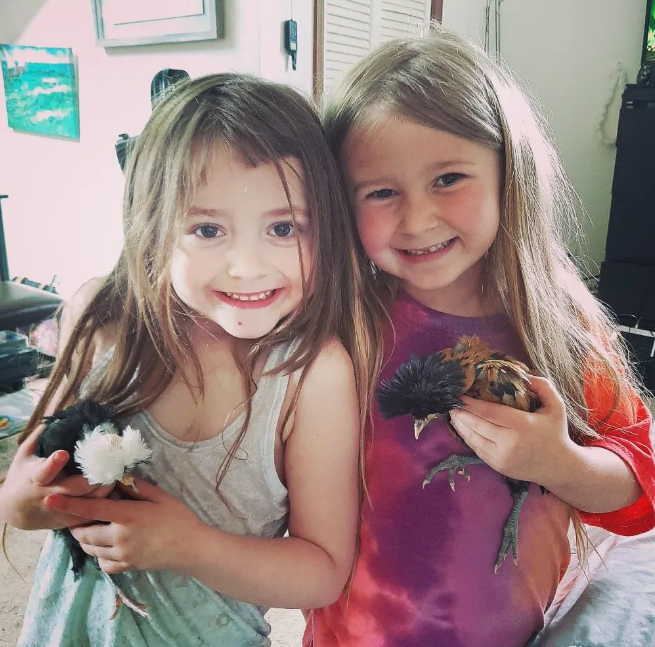
Polish are also some of the most friendly chickens around you will ever find! Our White Crested Black Polish are specifically extremely friendly and personable with people. They even love to be picked up and cuddled by the kids! Instead of just putting up with being carried around, they actually ask to be and then cluck happily away in your arms once picked up. Perhaps this is due to their funny hairstyles which prevents them from seeing? Maybe! They do tend to act a tad bit ditzy. But you will never find a chicken who enjoys your company so much as the Polish.
"I am really surprised at how much I actually like the [Polish] chickens. They are so cool and cute! With their funny hairdos and they are so silly. They are cool chickens."
A friend of the family needed a place to stay so we offered him free room and board if he would just help out with the animals (I admit, a large task). Although he was a country boy, he had never had any chickens of his own before, nor spent much time with them. We have many breeds right now, but he immediately bonded with the Polish, especially the White Crested Blacks. Every day, he is the first up to see them, the last in the coop at night and checks them all out mid-day to make sure they are okay. Whenever I catch him with them, he usually has either "Floof" or "Poof" perched on his arm or shoulder. He always tells me, "I am really surprised at how much I actually like the [Polish] chickens. They are so cool and cute! With their funny hairdos and they are so silly. They are cool chickens." (Dusty T.)
That isn't to say that they are not funny! These guys will run into things that they should see is there! Except that crazy hairdo of theirs usually gets into the way so they actually can't see very well. A way to help them combat this is to put their crazy feathers in a man-bun of sorts (or regular bun, if its a hen!) with a small, rubber hair tie. This will make it easier for them to look around.

Their lack of sight isn't their only comedic attribute though. Polish talk funny, run funny and just act funny altogether. If you up at them from below, they look quite funny while turning their heads back and forth and clucking happily at you. If their feathers on top of their heads are not in a bun, watch them as they run quickly by and tell me what they remind you of - a roadrunner! Now, if we could just teach them to say, "Beep, Beep!"
They never seem to be in a big hurry or worried about much. They often will just lay down and begin sunbathing in really awkward places and times and then look at you like you are the weird one! If kept in a mixed flock, make sure they are not with any bullies because they easily get picked on due to their slowness. They aren't generally ones to do the pecking either. Even our roosters don't do much fighting unless they really need to teach a new rooster who is the boss! After that, they move on in life and don't have to spar again very much. They are just pretty easy going little guys.

On the downside, this makes them sharkbait for many different kinds of animals, including your cat or dog if they are not good poultry animals. They are easy prey for large birds because they literally do not see them coming. They have a hard time running away from fox, raccoons, dogs, etc. because they easily get trapped since they can only see certain directions. Therefore, it is usually best to just protect them and keep them in a fenced in area, preferably one that has netting, a roof or some type of protection from above also.
If you have low dominance breeds like bantam Cochins and Silkies, Polish are the perfect combination and other bantam breeds generally do well with them also. I have also done well keeping them with Cream Legbars, Wellsummers, Marans and Salmon Favorelle. I do not like keeping them with Barred Rocks, Rhode Island Reds, ISA Brows, Wyandottes or Brahmas. I did not see any issues with Orpingtons, Sussex, Sapphire Gems or Americanas.

Are Polish Chickens Really From Poland?
Well, yes. And, no. You see, Polish chickens, or at least fowl that resembled Polish, began appearing throughout Dutch and Italian paintings and literature as early as the 13th century. As with most breeds, their exact origins are unknown but we know that their ancestors began appearing in artwork in the 1400s. Due to their fancy appearance, beautiful feathering and added colors, they were well-loved by artists which is beneficial for those putting together pieces of their history. However, we do not know if they actually started in Poland or if they came there from Asia or another route with tradesmen or even soldiers.
The Spanish soldiers held parts of the lowlands of Holland during the 16th century and may have actually brought the breed to Poland during the occupation, but this is unclear. Initially, they were called "Paduan" or "Patavian fowl" in Spain and Holland. It is believed that the Polish chickens gained their name from their similar appearance to that of Polish soldiers who wore feathered caps on their helmets. The other theory is that they gained the name due to their head shape because "pol" means "large head" in Dutch! However, after this they gained popularity in the area and became known as "Polish" or "Poland" chickens.
During the 1700s, Polish chickens made their way to England and France and grew in numbers due to their fancy appearance. They became so popular, in fact, that their oldest English reference to date is in a stone statue of a Polish-resembling chicken in The Vatican. The French especially loved them for their looks and their egg laying abilities. They made it all the way to the Americas as early as the 1830s and were accepted into the American Poultry Association (APA) by 1874 in Non-Bearded White Crested Black.
There are a few more fanciful versions of how this delightful fowl came to different parts around the world. My favorite tale was one I read on The Happy Chicken Coop which is a fun website about - you guessed it - chickens, their coops and their supplies. The story read, "in 1736, the King of Poland was unseated and fled to France. With him, in his ‘luggage,’ he brought his beloved Polish chickens. They became the darlings of French society at the time, being loved by the French aristocracy, and from then on, their future was assured." (https://www.thehappychickencoop.com/polish-chickens/) Although this story may be untrue, I want to believe it just out of fun!

Due to their early arrival in the Americas, they are considered a Heritage Breed here. In similarity, the first London Poultry show in 1845 featured Polish chickens in gold, silver spangled, black and white. In 1865, Britain released its first Book of Standards which included "Poland" chickens in white crested black, golden, silver colors. The USA has added many varieties to their standard at different times - the Bearded Silver, Golden, Buff Laced and White were accepted in 1883, the Non-Bearded Buff Laced in 1938, the Non-Bearded White Crested Blue in 1963, followed by the bantam varieties, Bearded White Crested Blue, and even a standard-sized White-Crested Black which is exceedingly rare! Even Australia has gotten into Polish chickens and accepted them into the Open Poultry Standards Australia in 1912, also in White Crested Black.
As with many breeds, following the World Wars, the Polish chicken almost went extinct because it was not a great egg producer. By this point, they had become an ornamental chicken primarily kept by poultry fanciers and showers. Since no one had the money for ornamental breeds that didn't lay well, people quit buying and producing them. Because of this, no one had any extra time to devote to hobby farming or ornamental breeding and the focus shifted to breeds that could produce eggs or meat very quickly. Polish do take a while to grow up all the way, more than many other breeds but less than Silkies. As such, you do not get eggs as early as other breeds and you only get 2-4 a week, whereas other egg-laying breeds will produce up to one egg a day!
Polish chickens almost died out completely and were hard to come by until the late 1900s when a few people heard about them and decided to start breeding them. Due to these people, the breed was saved and salvaged for the show table again. Many people choose to still show their Polish today because they generally do very well in show and showing has become the primary reason that they are not kept. In the last decade or two, Polish chickens have again started rising in popularity and now they are well-known and generally easy to come by. Many of the large hatcheries offer Polish chicks but beware, as with all other breeds offered through large hatcheries, they are not bred "to standard" and they may vary based on what is still left.
Why Do Polish Look so Funny?
Polish chickens are also called, "Top Hats" by many fanciers and are in a group of chickens called the "top hat" breeds. These also include the lesser known Houdans, Sultans, Spitzhaubens, Appenzellers, Brabanters, Crevecoeurs and more. The Polish chickens, along with a few other breeds, have skulls that close slower than most other birds, if at all. That means, the backside of their skull has an opening until they become an adult (usually). This slow growth causes the feathers to grow in the crazy patterns that it does. It also makes them more susceptible to being killed by older, bigger chickens who will deliver a deadly blow to the back of their heads. When they do this to a normal breed of chick, it will scalp or bald the chick, but they generally recover. In a Polish or other top hat breed though, these warning pecks can be more deadly. Care should always be taken when introducing younger Polish chicks to an older flock or if you keep a mixed flock with some breeds that are more dominant, check often to ensure even your adult Polish are not being pecked at. This is due to their more docile personality and nature.
As they mature, hens usually get a more "styled" hairdo that appears more clean and pom-pom like. Their heads actually create a ridge in their skull where it used to be opened and vulnerable. With their bones grown together, they begin to get more bold. Roosters top hat, however, will become more wild as they age! Their head feathers will grow all over and at different lengths, making it look wild and untamed. You can usually tell a rooster from a hen once they are grown just by looking at their top hat alone!
As babies though, Polish have a whole new level of cute! They have a small, round bun on top of their head that is elevated compared to other breeds. It is usually rounded, but I learned during my last picking that if you look for "cleaner" hairstyles as babies, it generally reigns true then too! (No promises!)
Just look at this adorable little chick with it's tiny "poof" on top of its head! What do you think it turned out to be? Rooster? Hen? (Look below to find out!)

What Else Should My Polish Look Like?
Worried about whether you actually got a Polish chick from the feed store? Well, let me help you out a bit! Your Polish chick should have at least a small "bowl" appearance on top of their head. Yes, some may be much smaller than others dependent upon your line of chick and how they develop. Or you may have one with a giant mop hanging over its eyes already! The top hat of the chick seems to grow as quickly as the rest of her and looks just as gangly and weird during their awkward stages as any other part of your chick! The top hat will have funny feathers sticking every different direction during molt time and during their puberty stages where they look just plain u-g-l-y. Wait it out. It will get better. I promise!
I tend to laugh at them during their awkward stages and make fun of them for being a silly teenager. When they look gangly and their feathers are changing from baby chick to grown plumage, you have to just look at them and laugh at their ridiculousness. It's okay though, because one day you will walk out and see them sitting there and go, "Dang, how did you go from that to THAT?"

Aside from their silly hairdo, they also have a very upright body type with their tail feathers pointing straight up also. This gives an almost "V" appearance from head to tail. Their backs should be straight and strong though, with tight wings and feathers. Their feet should be blue in most colors and should appear strong and large for their size. Their beak is pointed, eyes are red or amber in color and large and bright, despite their hidden stance.
Roosters are said to weigh only six pounds, but we have had one that was seven or eight pounds. Hens are only five to six pounds on average. They do appear somewhat larger though due to their bold appearance, high hairstyle and tail, and big feet. Bantams only weigh 1.5 to 1.8 pounds and are kept almost exclusively for ornamental purposes only.

How Many Colors and Varieties Are There?
In America, we have twenty-one colors, sizes and varieties accepted to the Accepted Breed Standard including - Bearded and Non-Bearded White, Non-Bearded White Crested Black, Non-Bearded White Crested Blue, Bearded and Non-Bearded Golden Laced, Bearded and Non-Bearded Silver Laced, Bearded and Non-Bearded Buff Laced, Bearded and Non-Bearded Golden Laced in both bantam and standard sized. Additionally, Non-Bearded Black Crested White is accepted in standard size.
Many specialized breeders created their own, new colors all the time, so beware: if you want to be able to show your chicken someday or care about the offspring that come from it, do not worry about whether the color is accepted and just have fun with it!
Other colors you might find in America may include: Splash, Blue, Black, Gold Laced, Silver Laced, Cuckoo, White Crested Chocolate or Lavendar, and even some Frizzled varieties! My favorites are the new colors called Candy Corn and Tolblunt. They are so pretty! Candy Corn is a mixture of black and white cuckoo with golden and buff tones laced in to it. Tolblunt chickens are similar at first glance, but up close you realize they do not have any cuckoo markings and instead are random spots of black, white, buff and gold. Both of these colors are being highly worked on each day!
In England, Non-Bearded White Crested Black, Bearded Golden Laced, and Bearded Silver Laced are the primary colors accepted. In Australia, Bearded Golden Laced, Silver Laced and Buff Laced are accepted as well as Non-Bearded White Crested Black and Blue. Australia also accepted Bearded White and Bearded Buff Laced that are listed. The Open Poultry Standards website claims, "Other colours available in Australia include Black, Buff, Cuckoo, Lavender, Splash, White Crested Blue, White Crested Cuckoo, White Crested Splash and Frizzled varieties." (http://www.openpoultrystandards.com/Polish)
Bearded varieties have an extra special "character" to them that makes them even funnier looking! We keep Bearded Golden Laced and Non-Bearded White Crested Blacks that all of the kids love to play with. They are very fun chickens to keep!

Additional Thoughts, Words or Gimmicks!
As mentioned a few times above, don't count on your Polish to lay a ton of eggs all the time like other egg layers. In the spring time or in the summer if they start laying, count on getting an average of two white, eggs a week, but up to four eggs. Do not count on them to lay during the fall or winter - they are heat tolerant and do well in the summertime but the cold days are not their mojo.
During the winter because of their comb being hidden, you may need to put vaseline or something else on your rooster's comb to make sure he does not get frostbite. The hens are far less susceptible because they have much smaller combs. Roosters are supposed to grow "devil horns" according to the breed standard, and are fairly intimidating looking with their high hairdo, devil horns and scary eyes.
Polish chickens are great with kids of all ages! They are perfectly happy to be carried around the yard like a baby and played with by the youngsters. They generally put up with everything the little girls will do to them, including dunking them in water, dressing them in baby clothes, carrying them around and flipping them over. They actually ask for attention by sitting at your feet and chirping politely!
Polish chickens are not the most economical and are not the best for either meat or eggs. They are a true ornamental breed not unlike Silkies which are most valued for their funny characteristics and charming personalities. Due to their unique appearance and sweet personalities, these birds have a way of earning their place in your yard.
#ChickenBreeds #PolishChickens #PoultryBreeds #PolishChicks #PolishChicken #WhiteEggs #EggLayer #OrnamentalBreeds #FunBreeds
References
American Poultry Association (2023) Breeds & Varieties, American Poultry Association, https://amerpoultryassn.com/accepted-breeds-varieties/
H., Meghan (June 27, 2022) Breed Spotlight: The Polish Chicken, Meyer Hatchery Blog, https://blog.meyerhatchery.com/2022/06/breed-spotlight-the-polish-chicken/
Lesley, C. (July 21, 2020) Polish Chicken: All You Need to Know, Chickens & More, https://www.chickensandmore.com/polish-chicken/
Nicolaus, R. (June 9, 2022) Pretty Bird: Polish Chickens Have Drawbacks, but are Loved for Their Looks, Midwest Messenger, https://agupdate.com/midwestmessenger/livestock/poultry/pretty-bird-polish-chickens-have-drawbacks-but-are-loved-for-their-looks/article_26c58dd2-ac55-11ec-8b7e-eb040478ce83.html
The Happy Chicken Coop (July 5, 2021) Polish Chickens: Temperament, Color & Egg Laying, The Happy Chicken Coop, https://www.thehappychickencoop.com/polish-chickens/
The Livestock Conservancy (2020) Polish Chicken, The Livestock Conservancy, https://livestockconservancy.org/heritage-breeds/heritage-breeds-list/polish-chicken/
The Open Poultry Standards Australia (October 10, 2022) Polish, The Open Poultry Standards Australia, http://www.openpoultrystandards.com/Polish
The Poultry Club (2023) Poland, The Poultry Club, https://www.poultryclub.org/breeds/chickens/soft-feather-light/poland/


Comments